Most websites don’t break. They bloat.
A plugin here. A builder add-on there. Another tracking script for a campaign that wrapped two years ago. None of it feels heavy on its own. Then one day the site that used to feel snappy takes a beat too long to settle, and shoppers start drifting before the page has even finished loading.
That’s where we found Jewels & Time: a jewellery and watch retailer with a site they genuinely liked the look of, sitting on a foundation that had quietly grown too heavy to carry it.
The brief: re-engineer, don’t redesign
This wasn’t a redesign. The client didn’t want a new look, a new layout or a new identity. They wanted the same store to feel faster.
So the rule was simple, and it never moved: keep the design and the functionality identical, and rebuild everything underneath it.
The brief wasn’t “make it look different.” It was “make it feel instant.”
The store was built on Elementor and the Rey theme, with a stack of page-builder plugins layered on top over the years. That combination is common, and it works right up until it doesn’t. Page builders like Elementor are flexible, but flexibility has a cost: they tend to output a lot of extra code, and the more add-ons you bolt on, the more weight every single page has to drag around before it can show anything to a customer.
Why a rebuild beats another round of “optimisation”
You can optimise a heavy site. You can cache it, compress its images and defer its scripts. We’ve done all of that many times, and it helps. But there’s a ceiling. At some point you’re polishing the bloat rather than removing it.
A conversion to Bricks Builder removes it. Bricks outputs far leaner code by design, which means the browser has less to download, parse and render. Same page, same pixels, a fraction of the baggage.
Converting sites to Bricks is something we do all the time, migrating stores off Elementor, Divi, WPBakery and other builders, stripping out the bloat while keeping the design and functionality intact. It’s a core part of what we offer, and you can read more about our Bricks Builder website conversions here. This project is that work in practice.
What we actually changed (in plain English)
It sounds technical. It isn’t. Not really. Here’s what the rebuild involved, translated out of developer-speak:
- Replaced Elementor and the Rey theme with Bricks. The single biggest change. The site’s entire front end was rebuilt to output clean, lightweight code instead of builder bloat.
- Stripped out the plugin stack that came with the old builder. Elementor and Crocoblock, the marketplace plugins, a whole cluster of tools that existed only to prop up the old setup. Gone, and replaced with a lean, Bricks-native toolkit.
- Migrated custom content from JetEngine (Crocoblock) to ACF. A more efficient way of handling the store’s custom fields and data, with less overhead.
- Moved WooCommerce to high-performance order storage. A faster, more modern way of storing orders behind the scenes, better for speed now, and better for scale later.
- Updated the server to PHP 8.4. A newer, faster engine running the whole thing.
- Consolidated redundant templates, styles and CMS modules. Years of accumulated extras, simplified down to what the site actually uses.
Nothing the customer sees has changed. Everything the browser has to do to show it to them has.
The result: speed
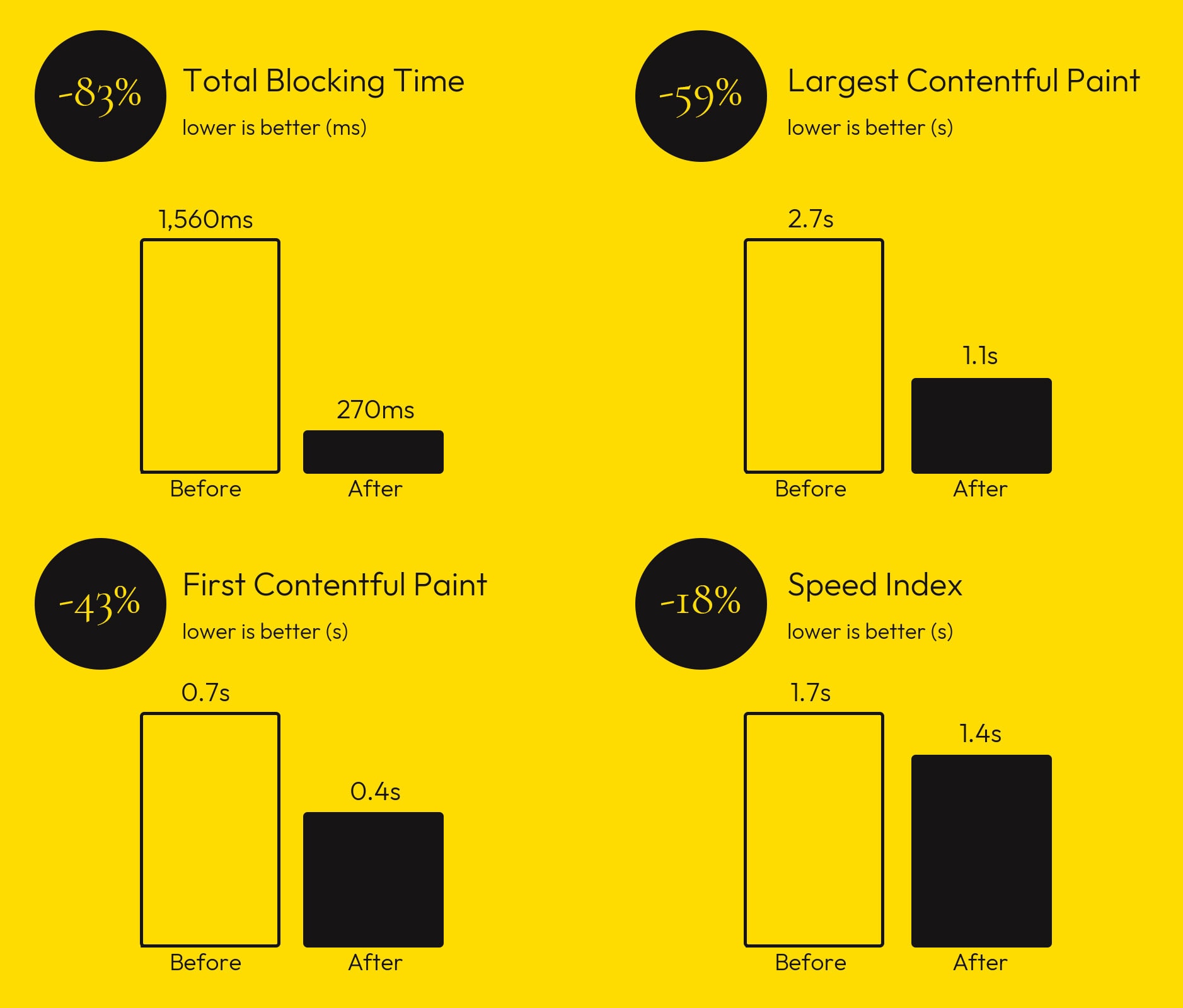
Here’s the before and after, measured on the two pages that matter most for a shop, the homepage and the product archive (the page customers browse to find what they’re buying):
| Metric | Homepage (before → after) | Shop archive (before → after) |
|---|---|---|
| First Contentful Paint | 0.5s → 0.4s | 0.7s → 0.4s |
| Largest Contentful Paint | 1.1s → 0.7s | 2.7s → 1.1s |
| Speed Index | 2.3s → 1.3s | 1.7s → 1.4s |
| Total Blocking Time | , | 1,560ms → 270ms |
| Cumulative Layout Shift | , | 0.117 → 0.003 |
The shop archive is the standout. This is the page a customer spends the most time on while deciding what to buy, and it’s where the old build was struggling hardest.
On the page that matters most to a shop, total blocking time, the lag before a page becomes properly interactive, dropped by more than 80%.
Largest Contentful Paint, the moment the main content actually appears, nearly halved on that page too. The store didn’t just get a little quicker. The slowest, most important parts of it got dramatically quicker.
The result: people
Speed is satisfying to measure, but it only matters if it changes behaviour. It did.
In the period following the rebuild, average daily visitors climbed 63%. Those visitors engaged at a healthy 69% rate and stayed on the site longer than they had before.
63% more real people, staying longer, doing more.
Faster sites are easier for customers to use and easier for search engines to favour. We won’t pretend speed was the only thing happening, but a steady, sustained rise in genuine traffic is exactly the kind of result a faster, leaner foundation is built to produce.

The takeaway
Speed isn’t a finishing touch, and it isn’t a feature you bolt on. It’s the baseline, the thing your customers feel before they’ve read a word of your copy.
If your site has slowly grown heavy, you don’t necessarily need to redesign it. You may just need to rebuild what’s underneath it.
Same love story. Better foundation.